human rights

#FreeAlaa

Submitted by ed on
#FreeAlaa

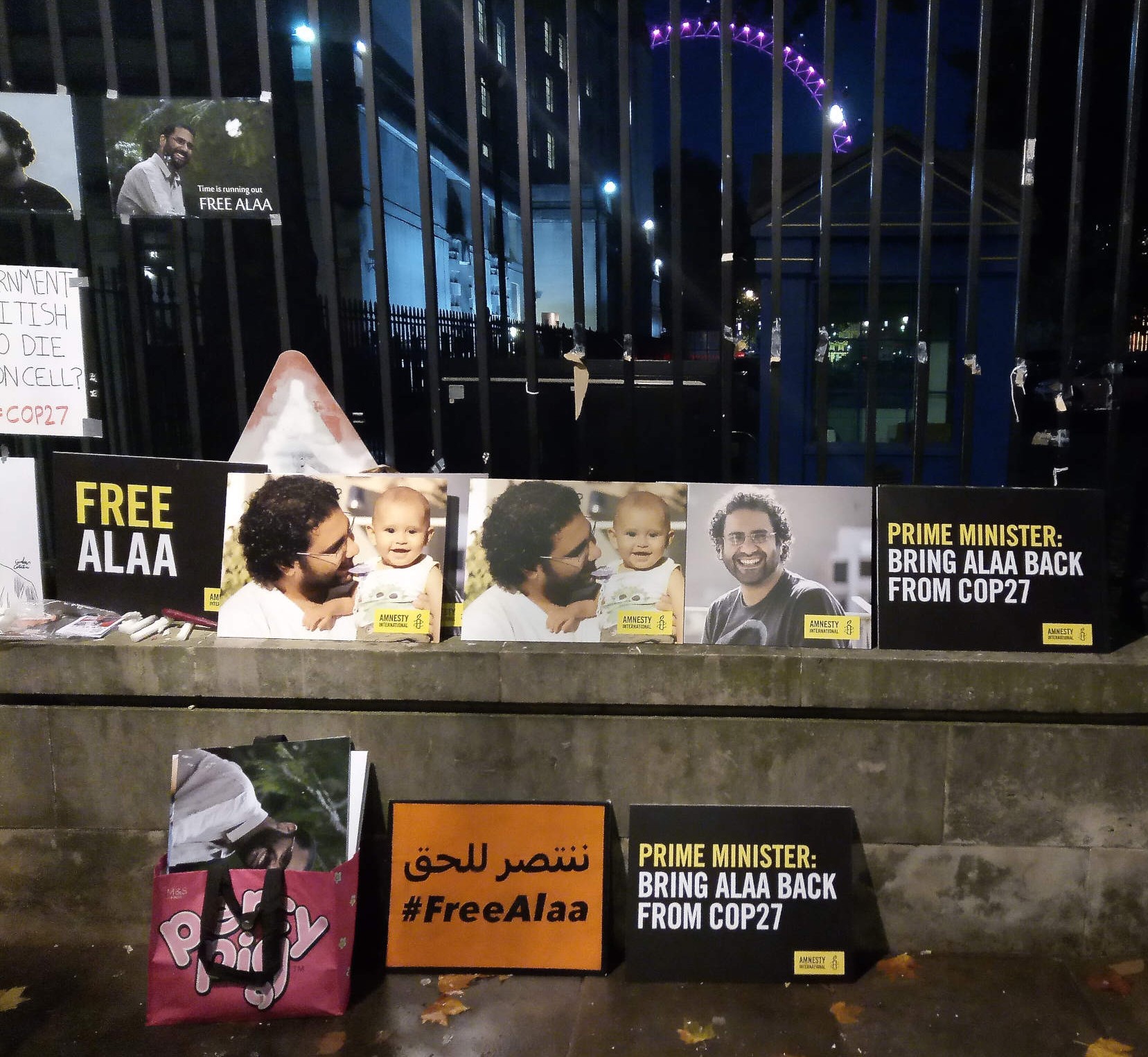
We at GreenNet add our voices to the urgent calls for Alaa Abd el-Fattah’s freedom. The human rights and digital rights campaigner has been on dry hunger strike in an Egyptian prison since Sunday. The desperate hope was that while the eyes of the world are on Egypt the British delegation to COP27 would secure Alaa's safe release from prison and transport to Britain, where he has citizenship.

In happier days Alaa helped GreenNet on website projects, encouraging us to develop in Drupal. We’ve kept in contact with his family through APC while his mistreatment at the hands of the el-Sisi government (and previous governments) of Egypt has grown worse.

GreenNet collective members joined the vigils in London on Sunday. While it is encouraging to see Alaa’s family’s campaign in the media during COP27 and in the mouths of politicians, Alaa’s situation is critical.

We are also deeply concerned for the welfare of Alaa's sister Sanaa since she has bravely returned to Egypt, and for the thousands of political prisoners and prisoners of conscience in Egypt.

Please support the campaign in any way you can at https://freealaa.net/take-action One easy action is to email your MP.

[[{"fid":"5888","view_mode":"full","fields":{"format":"full","alignment":"","field_file_image_alt_text[und][0][value]":"#FreeAlaa","field_file_image_title_text[und][0][value]":"#FreeAlaa","external_url":""},"link_text":null,"type":"media","field_deltas":{"2":{"format":"full","alignment":"","field_file_image_alt_text[und][0][value]":"#FreeAlaa","field_file_image_title_text[und][0][value]":"#FreeAlaa","external_url":""}},"attributes":{"alt":"#FreeAlaa","title":"#FreeAlaa","class":"media-element file-full","data-delta":"2"}}]]


Offline: Alaa Abd El Fattah 503 days in prison

Submitted by howard on
 
 
Alaa Abd El Fattah is a prominent Egyptian coder, blogger and activist who has been detained under every Egyptian head of state in his lifetime. In reporting on his case, Reuters called Alaa an “anti-Mubarak activist,” but his activism spans many issues—and governments. He protested the rule of Mubarak, but has also stood against military rule and the crackdowns initiated by former president Mohammed Morsi and current president Abdel Fattah el-Sisi.

Take Action

Join the Free Alaa campaign on Facebook

As a free software developer, Alaa has always been a vocal advocate for the creation and distribution of digital technologies that let everyone to speak freely and privately. In 2004, after organizing a Linux installfest for curious computer users, he co-founded the Egyptian GNU/Linux Users Group. As a Drupal developer, he built platforms for others to share their opinions; as a lead developer on the FLOSS translation utility Pootle, he made it easier for users around the world to use and contribute back to the shared commons of open source software. His dedicated support for the Arab Techies group and the Arab Digital Expression Summer Camps connected technologists across the Middle East with each other, and with a new generation of students.

Alaa's determination to deploy his understanding of new technology to amplify the message of his fellow Egyptians made him a prominent global voice during the Arab Spring. His online visibility made him a frequent target for the Egyptian authorities, even as it occasionally protected him from retaliation. Alaa was first arrested in 2006 under then-President Hosni Mubarak for participating in a peaceful protest in support of an independent judiciary on charges of “insulting the president.” Charged with "insulting the President," he served 45 days before being released amidst a global campaign for his freedom.

In 2011, Alaa was again arrested, and charged with “inciting violence” under the ruling Supreme Council of the Armed Forces (SCAF), in conjunction with the Maspero massacre, a violent attack by the army on protesters that left 27 civilians and one soldier dead. No evidence was produced at the trial, and Alaa was released after two months following international pressure.  

On November 28, 2013, police raided the Cairo home of Alaa’s family. Under a government overseen by then-General Abdel Fattah el-Sisi, he was arrested and detained for 115 days without trial. Along with more than 40 international organizations and individuals, we called on the Egyptian government to honor its commitments under the International Covenant on Civil and Political Rights (ICCPR).

In June 2014, accused of violating Egypt's protest law and attacking a police officer, he was convicted in absentia and re-sentenced to fifteen years in prison, after being prohibited from entering the courthouse. Following an appeal, Abd El Fattah was granted a retrial, and sentenced in February 2015 to five years in prison.

The sentences handed down to Alaa occur amidst a broader crackdown on freedom of expression, assembly, and opinion. Along with the Media Legal Defence Initiative, EFF has filed a petition to the United Nations Working Group on Arbitrary Detention on behalf of Alaa.

A campaign to end Egypt’s protest law contains information and updates on a variety of cases, including Alaa’s.  Although Alaa has been targeted for his prominence and ability to relay and amplify the truth through digital means, his treatment is emblematic of the plight that many Egyptian activists now face.

More Offline cases of imprisoned bloggers and technologists.


Reposted under Creative Commons with many thanks from:

https://www.eff.org/offline/alaa-abd-el-fattah

Economist and analyst John Aziz's latest blog "On the Dehumanization of Immigrants"

Submitted by howard on

Britain is in the grip of a worrying trend. Our own Prime Minister compared migrants in Calais to insects when he called them a “swarm”. Meanwhile, internet comment sections relating to the refugees are filled with hatred and venom. Asylum seekers are referred to as “invaders”, and the trolls encourage the British authorities to shoot them, to machine gun them, and hang them on meat hooks.

This dehumanization of immigrants frightens me. Not simply because dehumanization of large groups of people often foreshadows violence. It frightens me because this is just the tip of the iceberg. There is a lot more of this hateful stuff bubbling beneath the surface of our society. Anti-immigrant sentiment has been swelling in Britain for the last two decades, gently encouraged by tabloid journalists and other intellectually lazy people looking for an easy scapegoat for the economic and social problems of the age. As Richard Seymour noted last year in The Guardian, “77% of people in the UK want immigration reduced, and 56% want it ‘reduced a lot‘”.

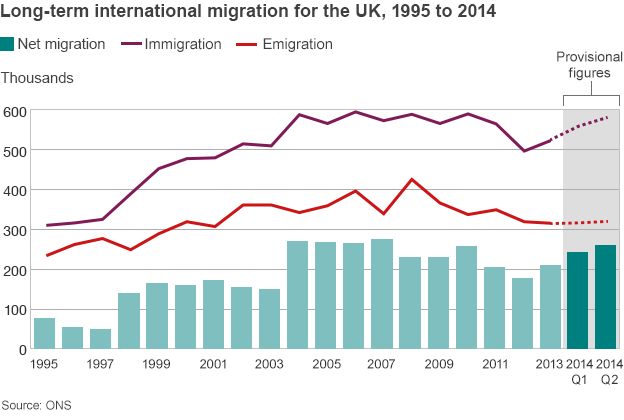
Britain has been subject to soaring inflows of immigration in the past twenty years. This has meant large-scale changes to the fabric of society, some of which people may like, but many of which they may not. And there is an additional burden on public services. IPSOS-Mori, for instance, found that there is a strong correlation across Europe between anti-immigrant sentiment and people’s perception of strain on public services. In that sense, anti-immigration sentiment in itself may not be entirely irrational.

Still, it does ignore the fact that there may be cleaner solutions to Britain’s problems than simplistically blaming immigration, and trying to clamp down on human movement. None of the strains on public services, health care and infrastructure would exist if only the government would properly scale investment in infrastructure and public services to demand. Immigrants pay more taxes than they draw out in services, so immigration has hardly made such investment unaffordable. Not to mention the billions of pounds in cheap lending that the private market made available to the government at negative real rates during the last parliament — money that could have been invested in infrastructure and public services — but which the government passed on.

As America — with its millions of undocumented migrants — is discovering, trying to stem flows of humans is very hard. People are slippy, and they go where they wish. Walls and fences are impediments, but they are not absolutes. People can be incredibly singleminded. The stories of the migrants in Calais who have escaped warzones, famines and despots in Africa and the middle east to slip into Europe, and across the Channel are a testament to the resilience of the human will. That resilience is why the anti-immigration internet trolls are setting their sights upon machine guns and meathooks and other such savagery. Walls and barbed wire and officers with searchlights and sniffer dogs isn’t working.

In the bigger picture, as anti-immigrant sentiment has swelled, there may be an overflow into the demonization and ostracization of ethnic minorities, even those who are here legally. Even those who were born here. Even those such as myself who were born here and are the children of white, English mothers. Even, perhaps, to white Britons who favour multiculturalism and immigration. The data shows that Britain is getting more racist, with 1 in 3 admitting to racial prejudice, up from 25 percent in 2001.

In the long run, I have no doubt that the economic benefits of migration — it’s estimated that completely open borders would roughly double global GDP via more efficient matching of workers and firms — will win out and that humanity will become increasingly transnational, and postnational, and ultimately interplanetary.

But for now, with this tidal wave of anti-immigrant and increasingly racist sentiment, I feel frightened at what my own country — a country that I have lived in my entire life — might be becoming.

Reposted with many thanks from Azizonomics http://azizonomics.com/2015/07/30/on-the-dehumanization-of-immigrants/

Interview with UN Special Rapporteur David Kaye on expression, opinion and religious freedom

Submitted by howard on

By Leila Nachawati Rego for APCNews

JAKARTA, Indonesia, 03 June 2015


APC interviewed the UN Special Rapporteur on the promotion and protection of the right to freedom of opinion and expression. David Kaye, who just published a report on the importance of encryption and anonymity for human rights, gave the opening keynote address at the Regional Consultation on Expression, Opinion and Religious Freedom in Jakarta (Indonesia) on 3-5 June.


APC welcomes Kaye’s efforts, which present a significant opportunity to strengthen fundamental freedoms in the digital age, and has contributed to his consultation. Our comments included corporate responsibility, women’s rights and sexual rights, and supported tools that protect privacy and anonymity online.

APC’s Leila Nachawati conducted the following interview with David Kaye in Jakarta.

Your recent report to the Human Rights Council mentions that corporations have a role in preserving the right to freedom of opinion and expression, but it does not get into details of their responsibilities. Will you be following up on this in upcoming reports?

Yes, the roles and responsibilities of corporations are a priority and we will be developing a strategy to follow up on this during the summer. This will be developed through two different tracks: on the one hand, we will be paying visits to several corporate actors – from Silicon Valley to private sector representatives in South Asia, China, and Europe – to pursue/convince them to adhere to principles like the Global Network Initiative’s, and other mechanisms to implement their human rights obligations. On the other hand we will work on thematic reporting on the role and responsibilities of the corporate sector.

Sexual expression is not seen to be as important as religious or political expression. What can we do to promote its inclusion as a free speech issue and to build alliances among free speech advocates and gender activists?

There are different ways to look at this. One is to reframe the issue of sexual expression within the language of Article 19 of the Universal Declaration of Human Rights. It can also be framed within the Right to Health. Can there be shared ground between my mandate and the health mandate? We should find ways to use the existing law and resources to advance these kind of issues.

At the international level there is less tension between freedom of expression and freedom of religion than there is at the national level. What can we do to resolve tensions at the national level, where religion is clearly being used to restrict freedom of expression?

It is not like this tension has been solved at the international level, but it is definitely easier to deal with than at the national and local level. Taking international themes and “selling” them nationally is crucial in our strategy, I think. Many power structures and institutions at national level will of course oppose, but we need to find the coalitions at national levels where these issues can be advanced, and convince them to strategise around the idea that freedom of expression enhances their rights.

Some people criticise freedom of expression as being “the freedom of the powerful to speak” (Charlie Hebdo and world leaders’ “defence of free speech”). How do we make sure that freedom of expression is not used to perpetuate existing power structures?

The answer is, on the one hand, more speech. But also, freedom of expression is fundamentally anti-power, and we want to ensure that we react to its instrumentalisation by the powerful. Power structures will continue to use freedom of expression to their advantage while they repress people’s exploration of new ideas that may threaten them. We need to work on finding more ways to respond to this and counter it.

Reposted under  CC BY-NC-SA 3.0 with many thanks from:

https://www.apc.org/en/news/interview-un-special-rapporteur-david-kaye-…